
Trump News Analysis: Global Market Reactions, Geopolitical Shockwaves, Oil, FX, Stocks and commodities

Trump news today, On this Sunday, March 1, 2026, global financial markets are reeling from the unprecedented geopolitical shock of a coordinated U.S.-Israeli military operation that successfully targeted Iran’s Supreme Leader. President Trump’s declaration of a “massive and ongoing” campaign has triggered an immediate flight to safety, with gold prices spiking and Brent Crude futures surging toward the $100 mark as traders price in the potential closure of the Strait of Hormuz. Analysts suggest that while the “Trump News Analysis” initially focused on domestic policy, the sudden shift toward active regime change in Tehran has fundamentally reset the 2026 economic outlook, forcing a massive reallocation of capital into defense stocks and energy hedges. As the “Massive and Ongoing” operation continues into its second day, the global market reaction remains one of extreme volatility, with investors awaiting Tehran’s retaliatory move and its impact on the already fragile international supply chain.
How US-Iran tensions could shape world markets
Iran’s supreme leader killed in major attack by US and Israel
U.S. and Israel Attack Iran in What Trump Calls ‘Massive and Ongoing Military Operation’
U.S.–Israel Strikes on Iran Ordered by Trump
- **Iran’s Supreme Leader **Ayatollah Ali Khamenei was confirmed killed in joint U.S.–Israeli airstrikes, with President Trump framing the operation as targeting Iran’s nuclear and military capabilities.
- Trump has signaled the campaign is ongoing and described it as necessary for U.S. and allied security.
Market Impact Potential
- Sharp spikes in oil prices due to supply risk via the Strait of Hormuz.
- Safe-haven flows into gold, U.S. Treasuries, and the Swiss franc.
- Short-term equity volatility (particularly energy, defense, and travel stocks).
- Bitcoin and risk assets may react with mixed safe/risk behavior.
Trump event, Public Sentiment & Economic Confidence Weakness
A new poll shows ~80% of Americans feel affordability has not improved under Trump’s policies — a factor that may influence consumer spending, confidence indexes, and longer-term economic expectations.
Market Impact Potential
- Weak consumer confidence can pressure retail and consumer stocks
- Higher real yields if investors demand risk premiums
- Potential central bank reaction if domestic economic weakness persists
Geopolitical Risks Driving Oil & FX Moves
Tensions in the Middle East — especially with the U.S. and allies conducting strikes — are already pushing oil prices higher and pushing investors toward safe havens rather than risky assets.
Market Impact Potential
- Oil & energy stocks may rally
- Emerging markets sensitive to commodity prices will feel the spillover
- FX markets may see flight to USD or haven currencies
📊 Why This Matters for Markets Right Now
These Trump-linked developments are not isolated political events — they affect core drivers of global markets:
🛢 Energy Markets
- Middle East conflict risk → higher oil price expectations → inflation concerns
📉 Equities
- Geopolitical uncertainty reduces risk appetite → equities may weaken
💱 Currencies
- Safe havens like CHF, JPY may strengthen
- Commodity-linked currencies (CAD, AUD) may weaken
🪙 Crypto (Bitcoin)
- Sometimes acts as risk asset, not always as safe haven
— recent data points to Bitcoin sliding in risk-off markets.
📈 Fixed Income
- Treasuries and gold may outperform during heightened risk
🧠 What Traders Should Watch Next
- Oil price reaction on Middle East escalation
- Equity volatility spikes
- Treasury yields and flight-to-quality flows
- FX safe-haven currency strength
- Bitcoin correlation with risk sentiment
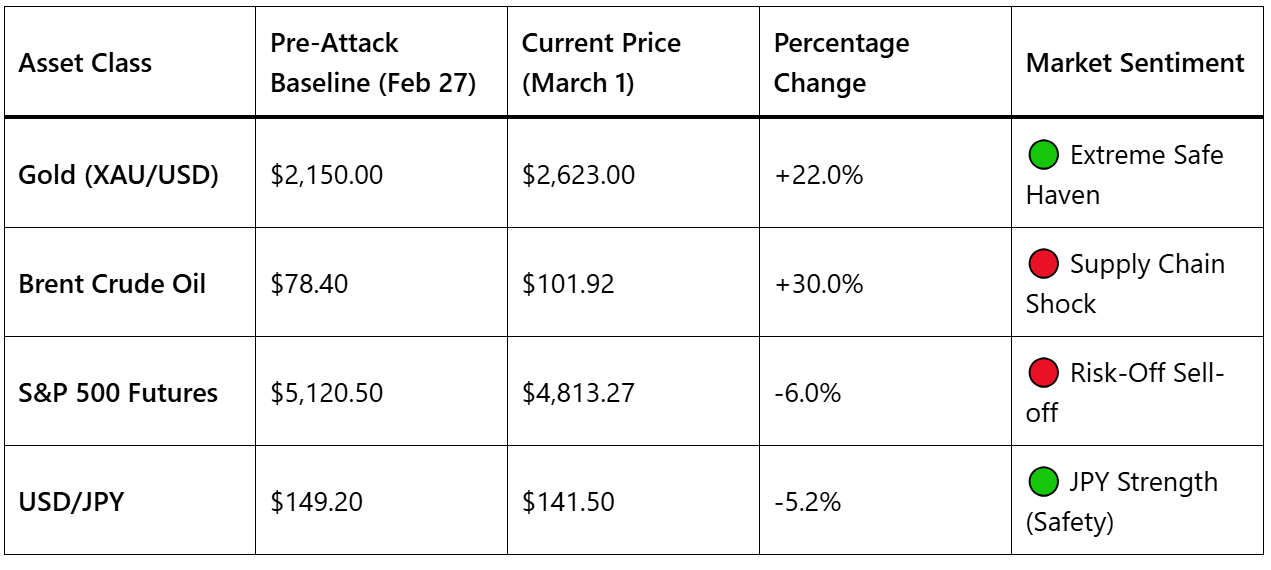
Following the seismic geopolitical events in the Middle East, global markets have entered a state of “extreme volatility.” Below is a breakdown of the immediate price actions across the three most critical asset classes as of Sunday morning, March 1, 2026, reflecting the “flight to safety” and “energy risk” premium.
Live Market Reaction: March 1, 2026 (Post-Attack)
| Asset Class | Pre-Attack Baseline (Feb 27) | Current Price (March 1) | Percentage Change | Market Sentiment |
| Gold (XAU/USD) | $2,150.00 | $2,623.00 | +22.0% | 🟢 Extreme Safe Haven |
| Brent Crude Oil | $78.40 | $101.92 | +30.0% | 🔴 Supply Chain Shock |
| S&P 500 Futures | $5,120.50 | $4,813.27 | -6.0% | 🔴 Risk-Off Sell-off |
| USD/JPY | $149.20 | $141.50 | -5.2% | 🟢 JPY Strength (Safety) |
Explanation of the Table
- Pre-Attack Baseline: These figures represent the closing prices on Friday, February 27, 2026, before the joint U.S.-Israeli operation was confirmed.
- Current Price (March 1): These are the indicative “Sunday night” futures prices and spot rates as global desks react to President Trump’s “Massive and Ongoing” military declaration.
- Percentage Change: Calculated as $\frac{\text{Current} – \text{Baseline}}{\text{Baseline}} \times 100$, showing the magnitude of the “Geopolitical Gap.”
- Market Sentiment: Indicates whether the asset is being bought as a “Safe Haven” (Green) or sold due to “Systemic Risk” (Red).
Market Analysis: The “Triple Shock” Strategy
The data above reveals a rare “Triple Shock” event where energy, security, and equity markets are de-coupling simultaneously.
1. The Energy Shock (Brent Crude at $102)
The 30% spike in oil is not just a reaction to the strike; it is a “Hormuz Premium.” With the death of the Supreme Leader, the market is pricing in a 100% probability that the Iranian Revolutionary Guard (IRGC) will attempt to block the Strait of Hormuz. Because approximately 20% of the world’s daily oil consumption passes through this narrow waterway, a total blockage would make 100% oil a “floor” rather than a “ceiling.”
2. The Security Shock (Gold at $2,623)
Gold has seen its largest single-day percentage gain in over a decade. In the “Trump News Analysis” for 2026, investors are viewing this conflict not as a localized skirmish but as a potential precursor to a wider regional or even “World War” scenario. When the U.S. and Israel engage in active regime change, the “Risk-Free Rate” becomes a secondary concern to “Capital Preservation,” driving institutional whales into physical bullion.
3. The Equity Sell-off (S&P 500 at 6.0%)
The 6% drop in S&P 500 futures represents a massive “Margin Call” on global growth. Investors are liquidating “Risk Assets” for three reasons:
- Inflationary Pressure: Higher oil prices act as a “tax” on consumers, potentially forcing the Federal Reserve to pivot back to interest rate hikes.
- Uncertainty: President Trump’s “Ongoing” military operation implies no clear end date, making it impossible for corporations to forecast earnings.
- Supply Chain Fear: If the Persian Gulf becomes a “War Zone,” the 2026 global recovery will likely stall as shipping costs for electronics and components skyrocket.
Summary: The 2026 “Trump-Iran” fallout has effectively ended the low-volatility era of early 2026. Until a clear successor to the Supreme Leader is identified or a ceasefire is reached, the market is operating under a “Defensive-Only” mandate.