
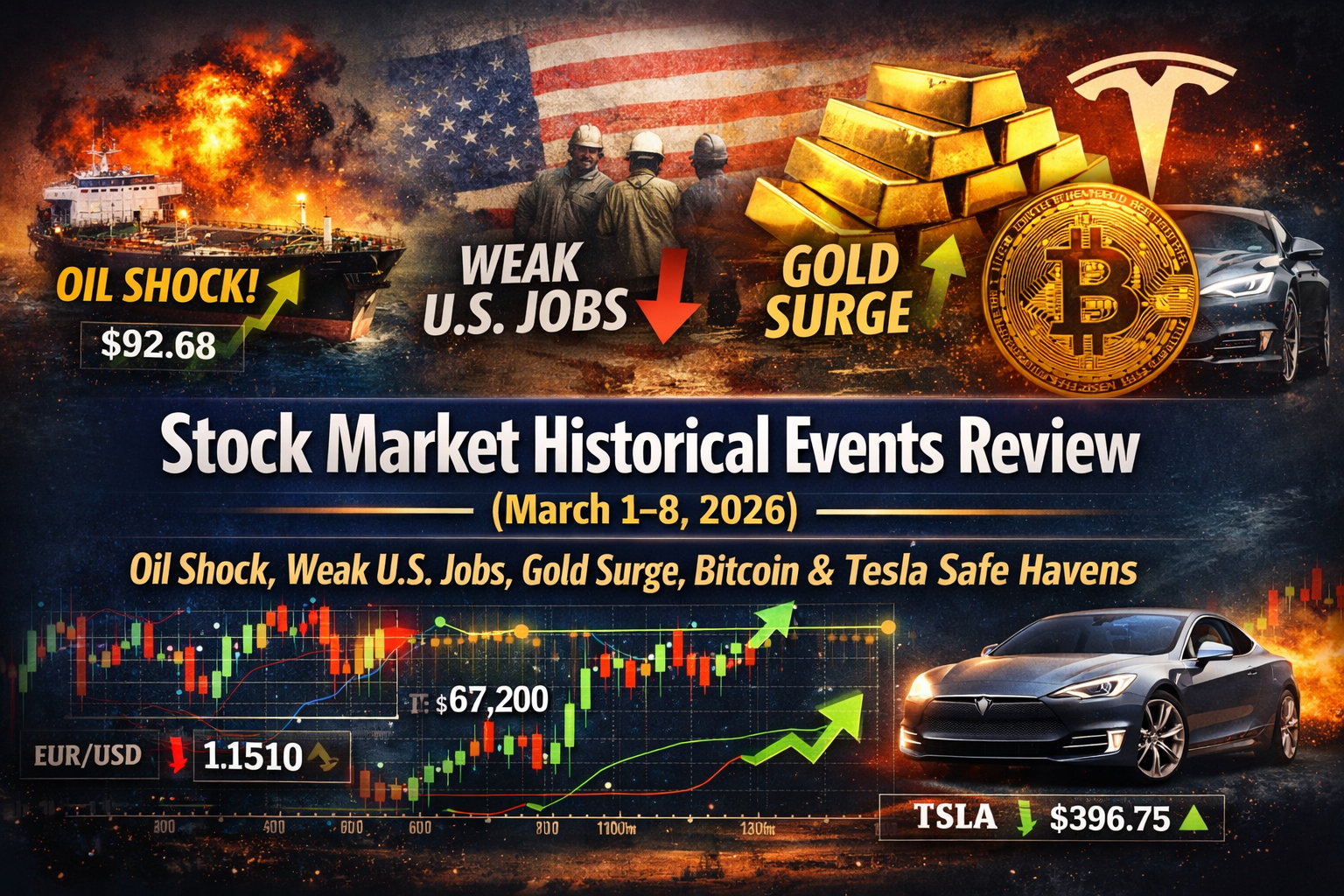
Stock Market Historical Events Review (Oil Shock, Weak U.S. Jobs, Gold Price Surge, Bitcoin and Tesla safe Havens) for (March 1–8, 2026)
Markets This Week: Oil Shock, Weak U.S. Jobs and Gold Surge Setup the Next Big Move
SEO title: Key Financial Market Events This Week (March 1–8, 2026): Gold, Oil, Forex, Bitcoin and Tesla Outlook
This weekend, we at https://checkthetrend.com has decided to present you with a full breakdown of the biggest stock market events that happened within the week of March 1–8, 2026. This events included the oil shock, weak U.S. jobs data, central-bank implications, and technical outlook for XAUUSD, Brent crude, EURUSD, GBPUSD, USDCAD, Bitcoin and Tesla. This article may also be used as a complete guide for the breakdown of the stock market events (March 1–8, 2026). Therefore sit tight and discover how oil shocks, weak U.S. jobs data, and geopolitical tensions moved gold, forex, Bitcoin, Tesla and global markets.
Global financial markets experienced major volatility this week as geopolitical tensions, economic data surprises, and energy market disruptions shaped investor sentiment.
Oil Shock Fears Rock Global Markets as Trump-Iran Crisis Escalates — Stocks, Gold and Forex React
Elon Musk News Today: Tesla Legal Risk, X Money, and Platform Changes Could Move Global Markets
Trump News Today (March 6, 2026): Oil Shock, Tariffs, and War Risks Shake Global Markets
The most important themes included:
- A sharp rise in oil prices due to Middle East tensions
- A weaker-than-expected U.S. jobs report
- Renewed safe-haven demand for gold
- Major currency movements in EURUSD, GBPUSD, and USDCAD
- Volatility in Bitcoin and Tesla stock
These developments created a complex trading environment where fundamental news and technical levels aligned to drive market direction.
External data referenced from:
- https://www.reuters.com
- https://www.forexfactory.com
- https://www.tradingview.com
- https://www.investing.com
Weekly market highlight
The dominant story this week was the Middle East energy shock. As the U.S.-Israeli conflict with Iran disrupted flows through the Strait of Hormuz, oil and gas prices surged, inflation fears returned, and markets moved into a classic risk-off rotation: oil up, gold supported, equities pressured, and FX driven by a tug-of-war between safe-haven demand for the dollar and weaker U.S. macro data.
The second major event was the February U.S. jobs report. Nonfarm payrolls fell by 92,000 instead of rising, unemployment ticked up to 4.4%, and wage growth stayed firm at 3.8% year over year. That combination mattered because it increased stagflation fears rather than delivering a clean “Fed cut bullish” signal.
A third important theme was policy uncertainty. Treasury Secretary Scott Bessent said the U.S. was likely to raise the temporary global tariff rate to 15% this week, while Fed commentary continued to stress inflation risks even before the weak payroll print. That kept markets from fully pricing an easy dovish pivot.
Key Market Events That Drove stock Markets
1. Oil shock from the Strait of Hormuz disruption
Brent crude exploded higher as shipping and production disruptions hit a region responsible for a huge share of global energy flows. Reuters reported Brent at about $92.69 by Friday, while analysts at Barclays said Brent could test $120 if tensions persist; Goldman Sachs warned prices could exceed $100 if Hormuz flows do not recover.
Why markets reacted
Energy is the market’s inflation transmission channel. Higher oil raises inflation expectations, tightens financial conditions, hurts growth-sensitive assets, and changes central-bank pricing quickly. ECB accounts also showed higher oil and industrial metal prices were major contributors to the upward revision in 2026 inflation compensation.
Oil Prices Surge After Middle East Tensions

One of the biggest drivers of global markets this week was the sharp increase in oil prices.
Tensions in the Middle East increased the risk of supply disruptions through the Strait of Hormuz, a key shipping route responsible for nearly 20% of global oil transportation.
As a result:
- Brent crude surged above $92
- Energy stocks gained
- Inflation expectations increased
If disruptions persist, analysts believe oil could test $100 per barrel or higher.
External reference:
https://www.reuters.com/markets/commodities/
Why this matters for markets
Higher oil prices typically trigger:
- higher inflation expectations
- tighter monetary policy
- pressure on stock markets
- support for commodity currencies
2. U.S. nonfarm payrolls missed badly
The U.S. economy lost 92,000 jobs in February, versus expectations for a gain, while unemployment rose to 4.4%. Markets initially treated the data as bond-bullish and dollar-negative, but the move was tempered by the simultaneous oil spike.

Why markets reacted
Weak labor data normally supports rate-cut expectations, but this report landed during an oil shock. That made the message more complicated: slower growth plus higher energy costs equals a stagflation risk, not a simple risk-on setup. Reuters reported investors increased bets on a June Fed cut, while still expecting the Fed to hold in March.
U.S. Jobs Data Shocks the Market

The U.S. Non-Farm Payroll report released this week surprised investors.
Key highlights:
- Jobs declined by about 92,000
- Unemployment rose to 4.4%
- Wage growth remained elevated
This data created uncertainty because it suggested slowing economic growth but persistent inflation pressure.
Market reaction
The immediate reaction included:
- Gold rising on safe-haven demand
- USD volatility
- Bond yields falling
- Rate-cut expectations increasing
Official data source: https://www.bls.gov
3. Gold stayed structurally supported, even with cross-currents
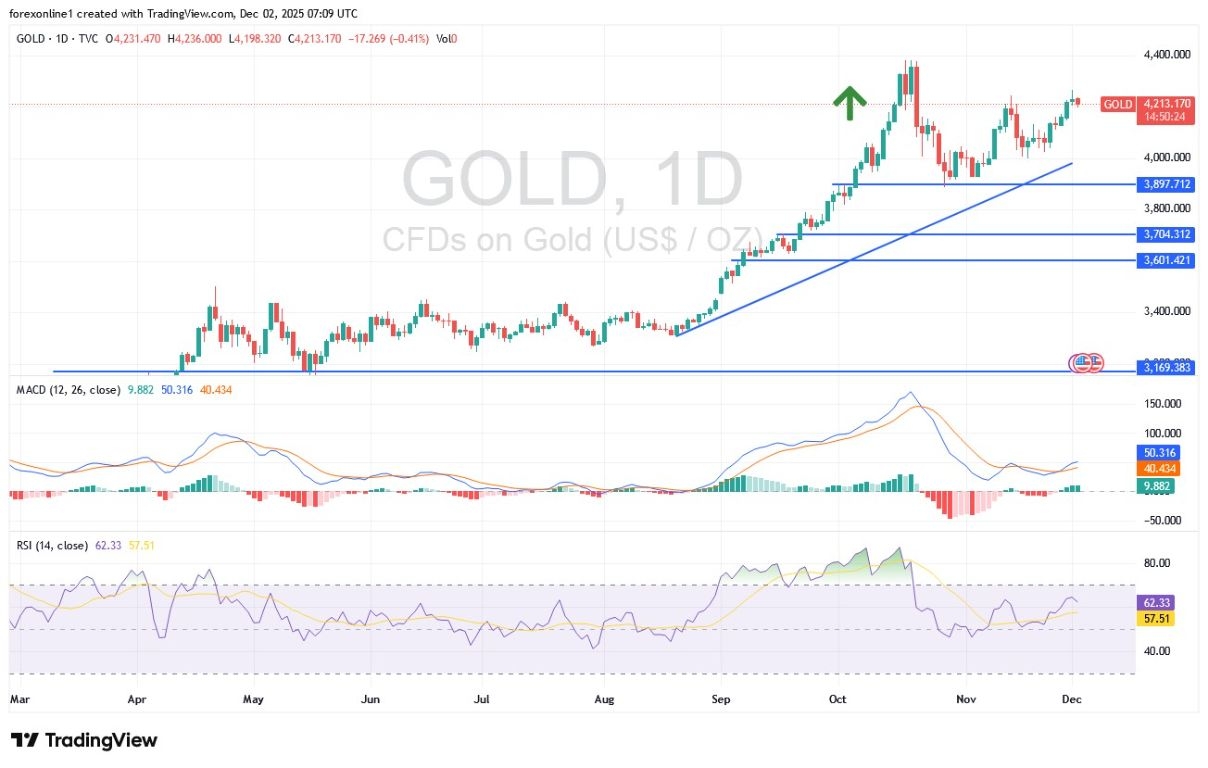
Spot gold rose to about $5,149 on Friday after the payrolls report, helped by safe-haven demand and lower rate expectations, though Reuters still said it was heading for its first weekly decline in five weeks because a firmer dollar and algorithmic selling capped gains earlier in the week.
Why markets reacted
Gold had two opposing forces all week: geopolitical demand and weaker U.S. data on one side, versus a strong dollar and rising inflation expectations on the other. That usually creates wide intraday swings rather than a smooth trend.
Gold Prices Remain Supported

Gold remained one of the most closely watched assets this week.
The precious metal benefited from:
- geopolitical risk
- weaker economic data
- rising financial uncertainty
XAUUSD Key Technical Levels
Support levels
- 5100
- 5050
Resistance levels
- 5195
- 5250
If gold holds above 5100, the next upside target could be 5250.
Gold analysis reference: https://www.investing.com/commodities/gold
4. European FX repriced around energy risk
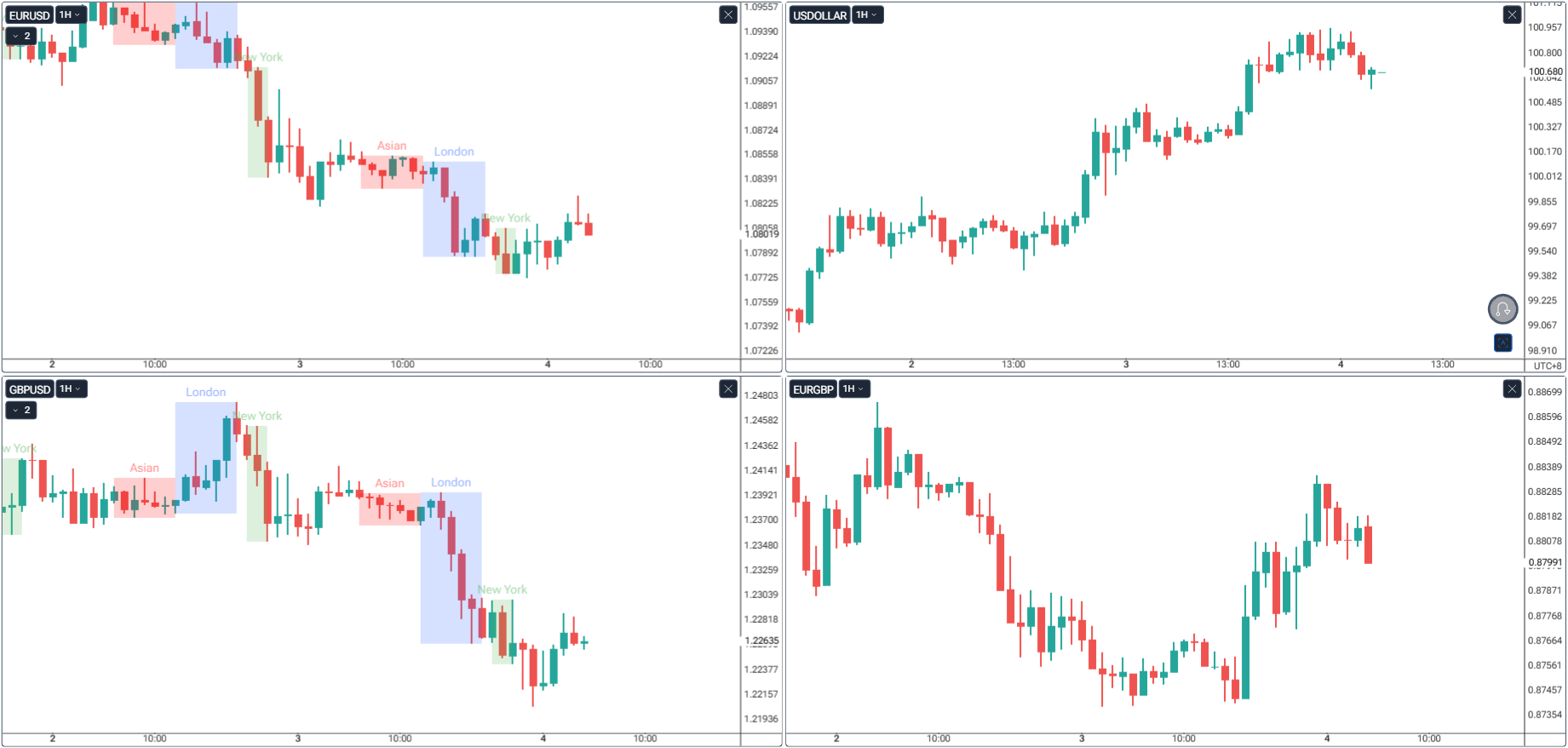
EUR/USD and GBP/USD both faced pressure from the oil spike because Europe and the UK are more exposed to imported energy shocks. Reuters reported sterling sank toward a weekly loss as markets sharply reduced near-term Bank of England cut expectations; ECB officials also emphasized vigilance as war-driven energy costs threatened inflation.
Why markets reacted
Oil strength is usually a tax on energy importers. It worsens terms of trade, lifts inflation, and can weaken growth, which is typically a bad mix for the euro and pound unless the dollar is falling even faster.
Forex Market Technical Outlook
Forex markets moved sharply this week as traders adjusted positions based on energy prices and economic data.
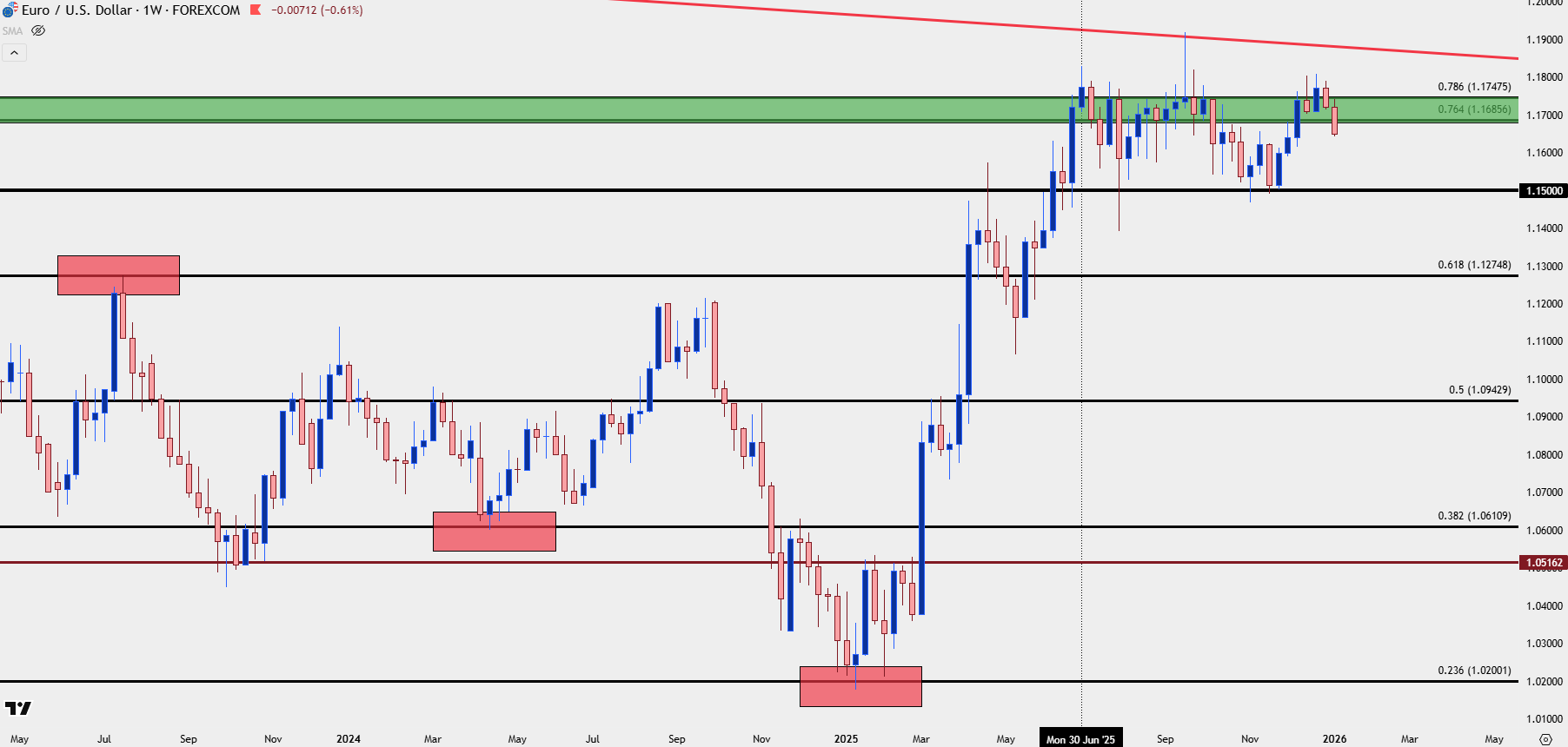
EURUSD
Support
- 1.1500
- 1.1450
Resistance
- 1.1620
- 1.1700
Market bias: Neutral to bearish below 1.1620
GBPUSD

Support
- 1.3300
- 1.3200
Resistance
- 1.3410
- 1.3500
Market bias: Bearish unless oil prices stabilize
USDCAD
Support
- 1.3570
- 1.3500
Resistance
- 1.3690
- 1.3750
Because Canada is a major oil exporter, higher crude prices strengthened the Canadian dollar.
Forex data reference:
https://www.forexfactory.com
5. The Canadian dollar outperformed on oil
USD/CAD was one of the cleaner macro trades this week. Reuters reported the loonie strengthened to 1.3578 per U.S. dollar, its strongest level since February 12, as oil surged and U.S. payrolls disappointed.
Why markets reacted
Canada benefits from higher crude prices because oil is a key export. That gave the Canadian dollar support even while broader risk sentiment stayed fragile.
5. Cryptocurrency and Tech Stocks

Crypto and tech stocks remained volatile.
Bitcoin (BTC)
Current range
Support
- 66,000
- 65,000
Resistance
- 68,200
- 70,000
A breakout above 70k could trigger strong bullish momentum.
Crypto market data:
https://www.coindesk.com/markets/
Tesla Stock

Tesla remained volatile amid broader technology sector uncertainty.
Key levels:
Support
- 394
- 385
Resistance
- 406
- 420
If Tesla breaks above 406, the stock may attempt a move toward 420.
Stock analysis source:
https://www.marketwatch.com/investing/stock/tsla
Fundamental drivers behind the moves
The market had four main drivers this week.
First, geopolitics. The Iran conflict disrupted production, exports, and shipping, and traders began pricing a non-trivial risk of a longer supply shock.
Second, inflation repricing. Higher oil immediately pushed markets to reduce expectations for near-term easing in Europe and the UK, while also complicating the Fed path in the U.S.
Third, weaker U.S. growth data. The payroll miss shifted attention from “higher for longer” to “how long can growth absorb this?”
Fourth, trade-policy noise. Bessent’s comments about a possible 15% temporary global tariff rate kept a floor under macro uncertainty and made it harder for markets to price a clean recovery trade.
Key market levels and trade map
These are zones, not guarantees. They are based on current spot/settlement references, this week’s reported trading ranges, and the way macro drivers are lining up into next week.
| Asset | Current reference | Support | Resistance | Bias into next week |
|---|---|---|---|---|
| XAUUSD | 5,149 | 5,100 / 5,050 | 5,195 / 5,250 | Bullish above 5,100 |
| Brent Crude | 92.69 | 90.00 / 88.00 | 95.00 / 100.00 | Bullish while Hormuz risk lasts |
| EURUSD | 1.1618 | 1.1500 / 1.1450 | 1.1620 / 1.1700 | Neutral-bearish below 1.1620 |
| GBPUSD | 1.3335–1.3411 area | 1.3300 / 1.3200 | 1.3410 / 1.3500 | Bearish unless oil eases |
| USDCAD | 1.3578 | 1.3570 / 1.3500 | 1.3690 / 1.3750 | Bearish if crude stays strong |
| Bitcoin | 67,172 | 66,600 / 65,000 | 68,200 / 70,000 | Range-bound to mildly bullish |
| Tesla | 396.73 | 394 / 385 | 406 / 420 | Neutral; needs tech risk appetite |
Sources for reference prices: Reuters market quote pages and finance data.
Instrument-by-instrument outlook
XAUUSD
Gold is still the cleanest hedge against the current mix of war risk, softer U.S. labor data, and uncertain policy. The biggest near-term support zone is around 5,100; if that holds, the market can retest 5,195 and then 5,250. A break below 5,100 would suggest the dollar and yields are temporarily overpowering the safe-haven bid.
Brent crude
Brent is the market’s leading macro signal right now. As long as Strait of Hormuz disruption remains unresolved, dips toward 90 look buyable and the next upside targets sit around 95 and 100, with some banks discussing even higher stress-case scenarios. A fast de-escalation would be the main reason this bullish structure fails.
EURUSD
EUR/USD is caught between two opposing forces: weak U.S. labor data should normally help the euro, but Europe’s inflation and growth outlook worsens when energy spikes. That leaves 1.1500 as key support and the 1.1620–1.1700 band as resistance. Below 1.1620, rallies still look vulnerable.
GBPUSD
Sterling looks more fragile than the euro because Reuters reported a sharp repricing of BoE cut expectations while UK growth forecasts were also marked down. The market needs to reclaim 1.3410 decisively to improve the chart; otherwise, 1.3300 and 1.3200 remain the downside magnets.
USDCAD
This pair is now a direct referendum on whether oil stays elevated. If Brent remains above 90, USD/CAD can keep grinding lower toward 1.3500. A reversal higher through 1.3690 would suggest either oil is cooling or the dollar’s haven bid is taking back control.
Bitcoin
Bitcoin is trading more like a high-beta macro asset than a pure hedge here. At about $67,172, it is holding above the intraday low near $66,636 but remains under the psychological $70,000 area. Holding 66k keeps a recovery toward 68.2k and 70k alive; losing that zone opens a deeper risk-off retracement.
Tesla
Tesla finished around $396.73, with the market still balancing enthusiasm for AI and autonomy against broader tech volatility and macro risk. Near-term support sits at 394 and then 385, while a push through 406 would be the first sign buyers are regaining control.
What could predict next week’s price movement
The next directional move will likely depend on three questions.
Will energy disruption persist? If yes, Brent and gold likely stay supported, GBP stays pressured, and USD/CAD likely trends lower.
Will markets treat weak payrolls as recessionary or rate-cut supportive? If recession fears dominate, Bitcoin, Tesla, and high-beta FX can stay heavy. If lower-rate expectations dominate, gold and selected risk assets can extend rebounds.
Will policymakers harden their inflation stance? ECB commentary already points to vigilance; if similar rhetoric broadens, rate-cut expectations may keep getting pushed back, especially in Europe and the UK.
Best article title options for clicks
- Markets This Week: Oil Shock, Weak Jobs Data and Gold’s Next Breakout
- Why Gold, Oil, EURUSD and Bitcoin Moved This Week: Full Market Breakdown
- Financial Market Events This Week: The Oil Spike, Fed Puzzle and Top Trade Setups
- Gold, Brent, EURUSD, Bitcoin and Tesla Outlook After This Week’s Biggest Market Shock
- This Week in Markets: Oil Surge, Payroll Shock and the Technical Levels Traders Are Watching
Suggested authority links to cite in your article
Use these source links from the citations above when publishing: Reuters market coverage, the U.S. Bureau of Labor Statistics employment release, ECB policy accounts, and OPEC statements. Those are the strongest authority sources behind this week’s moves.
Bottom line
This week was defined by an oil-driven geopolitical shock colliding with weaker U.S. labor data. That combination is what made price action so difficult: oil bullish, gold supported but choppy, euro and pound vulnerable, CAD stronger on crude, and Bitcoin/Tesla stuck between lower-rate hopes and broader risk aversion. Unless the Middle East situation cools materially, energy and inflation are likely to remain the main market drivers into next week.
VIEW US payrolls for February disappoint Wall Street
Iran war threatens prolonged hit to global energy markets

Sterling slides as Middle East conflict lifts oil prices, muddies rate outlook
Market Drivers That Could Move Prices Next Week
The next major market moves will depend on several critical factors.
Geopolitical developments
If tensions escalate in the Middle East, markets could see:
- higher oil prices
- stronger gold
- weaker global equities
Central bank expectations
Investors are closely watching the Federal Reserve, ECB, and Bank of England.
Key question:
Will central banks prioritize inflation control or economic growth support?
Central bank insights:
https://www.federalreserve.gov
https://www.ecb.europa.eu
Economic data releases
Upcoming reports likely to move markets include:
- inflation data
- retail sales
- manufacturing PMI
- consumer sentiment
Economic calendar:
https://www.forexfactory.com/calendar
Market Summary
This week’s market activity was defined by three major forces:
- Rising oil prices
- Weak economic data
- geopolitical tensions
As a result:
- Gold stayed supported
- Oil surged
- Forex markets became volatile
- Bitcoin traded sideways
- Technology stocks remained uncertain
If oil prices continue rising, markets may face higher inflation risks and increased volatility in the coming weeks.
FAQ (SEO Rich Snippet Schema)
What were the biggest financial market events this week?
The biggest financial market events included rising oil prices due to Middle East tensions, weak U.S. jobs data, increased gold demand, and volatility in forex, cryptocurrency, and tech stocks.
Why did oil prices rise this week?
Oil prices increased due to geopolitical tensions affecting supply routes in the Middle East, particularly around the Strait of Hormuz.
What is the outlook for gold prices?
Gold remains supported by geopolitical risks and economic uncertainty. If support near 5100 holds, the next resistance levels are around 5195 and 5250.
Which forex pairs moved the most this week?
Major forex movements occurred in:
- EURUSD
- GBPUSD
- USDCAD
These were influenced by oil prices, economic data, and central bank expectations.
How did Bitcoin perform this week?
Bitcoin traded in a consolidation range between 66,000 and 70,000, reflecting mixed sentiment across global financial markets.
Stock Markets News This Week: Oil Shock, Weak Jobs Data and Gold’s Next Breakout
Oil, Gold and Forex Surge: What Moved Global Markets This Week
Weekly Market Breakdown: Oil Spike, Forex Volatility and Bitcoin Outlook
Oil Shock Fears Rock Global Markets as Trump-Iran Crisis Escalates — Stocks, Gold and Forex React
Elon Musk News Today: Tesla Legal Risk, X Money, and Platform Changes Could Move Global Markets
Trump News Today (March 6, 2026): Oil Shock, Tariffs, and War Risks Shake Global Markets